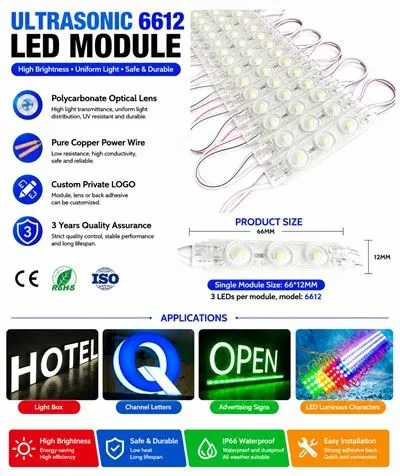
In the ever - evolving world of lighting technology, energy efficiency has emerged as a crucial factor for both consumers and businesses. As a supplier of 3030 LED Edge Modules, I am often asked about the energy - efficiency of these products. In this blog post, I will delve into the science behind 3030 LED Edge Modules and explore whether they truly live up to the standard of being energy - efficient.
Understanding 3030 LED Edge Modules
Before we discuss energy efficiency, it's essential to understand what 3030 LED Edge Modules are. The "3030" refers to the dimensions of the LED chip, which measures 3.0mm x 3.0mm. These modules are designed to be used in edge - lighting applications, such as backlighting for displays, signage, and architectural lighting. They offer several advantages, including high brightness, good color rendering, and a relatively small form factor.
How LED Technology Contributes to Energy Efficiency
LEDs, or light - emitting diodes, are fundamentally different from traditional lighting sources like incandescent bulbs and fluorescent tubes. Incandescent bulbs produce light by heating a filament until it glows, which is an incredibly inefficient process. A large portion of the energy consumed by an incandescent bulb is wasted as heat, with only about 5 - 10% of the energy being converted into visible light.
Fluorescent tubes, on the other hand, work by passing an electric current through a gas to produce ultraviolet light, which then strikes a phosphor coating on the inside of the tube to produce visible light. While fluorescent tubes are more energy - efficient than incandescent bulbs, they still have some drawbacks, such as the presence of mercury and relatively poor color rendering in some cases.
LEDs, however, produce light through a process called electroluminescence. When an electric current is applied to the semiconductor material in an LED, electrons recombine with holes, releasing energy in the form of light. This process is much more efficient, with modern LEDs capable of converting up to 80 - 90% of the electrical energy into light.
Energy - Saving Features of 3030 LED Edge Modules
One of the key energy - saving features of 3030 LED Edge Modules is their high luminous efficacy. Luminous efficacy is a measure of how efficiently a light source converts electrical power into visible light, and it is measured in lumens per watt (lm/W). 3030 LED Edge Modules typically have a high luminous efficacy, which means they can produce a large amount of light while consuming relatively little power.
Another energy - saving aspect is the ability to control the brightness of 3030 LED Edge Modules. Many of these modules are dimmable, allowing users to adjust the light output according to their needs. For example, in a signage application, the brightness of the LEDs can be reduced during off - peak hours or in areas with low ambient light, resulting in significant energy savings.
Furthermore, 3030 LED Edge Modules have a long lifespan. Compared to traditional lighting sources, which may need to be replaced frequently, LEDs can last for tens of thousands of hours. This not only reduces the cost of replacement but also the energy and resources required to manufacture and transport new bulbs.
Real - World Energy Savings
To illustrate the energy - saving potential of 3030 LED Edge Modules, let's consider a real - world example. Suppose you have a display that is currently using traditional fluorescent tubes for backlighting. The fluorescent tubes consume 40 watts of power each, and you have 10 tubes in the display, resulting in a total power consumption of 400 watts.
If you were to replace these fluorescent tubes with 3030 LED Edge Modules, and assuming each module consumes only 10 watts of power, you would need approximately 40 modules to achieve the same level of brightness. The total power consumption of the LED modules would be 400 watts, but considering the higher luminous efficacy and the ability to dim the LEDs, you could potentially reduce the power consumption by up to 50% or more.
Comparing with Other LED Modules
When it comes to energy efficiency, it's also interesting to compare 3030 LED Edge Modules with other types of LED modules. For instance, the 2835 Led Module 220v is another popular type of LED module. While both 3030 and 2835 modules are energy - efficient, the 3030 modules generally offer higher brightness and better performance in edge - lighting applications.
The IP68 1935 DMX512IC Full Color RGBIC LED Module is designed for more complex lighting scenarios, such as full - color dynamic lighting. Although it may consume more power than a simple 3030 module due to its additional features, it still benefits from the overall energy - efficient nature of LED technology.
The 0612/0816 Pure Silicone Integrated Neon Light is another alternative. It offers a different aesthetic compared to 3030 LED Edge Modules but also has its own energy - efficiency characteristics. In general, all these LED products are more energy - efficient than traditional lighting sources.
Environmental Impact
In addition to energy savings, the use of 3030 LED Edge Modules also has a positive environmental impact. As mentioned earlier, LEDs produce less heat, which means they can reduce the load on air - conditioning systems in buildings. This further contributes to energy savings and a lower carbon footprint.
Moreover, since LEDs do not contain hazardous materials like mercury, they are more environmentally friendly to dispose of compared to fluorescent tubes. This is an important consideration in today's world, where environmental sustainability is a growing concern.
Conclusion
In conclusion, 3030 LED Edge Modules are indeed energy - efficient. Their high luminous efficacy, ability to be dimmed, long lifespan, and other energy - saving features make them a great choice for a wide range of edge - lighting applications. Whether you are looking to reduce your energy costs, improve the lighting quality of your displays, or contribute to a more sustainable environment, 3030 LED Edge Modules are a reliable option.
If you are interested in learning more about our 3030 LED Edge Modules or are considering a purchase for your lighting project, we encourage you to contact us for further discussion. Our team of experts is ready to assist you in finding the best lighting solutions for your specific needs.


References
- "LED Lighting Technology: A Guide for Building Owners and Facility Managers," U.S. Department of Energy.
- "Energy - Efficient Lighting: The Basics," Lighting Research Center, Rensselaer Polytechnic Institute.