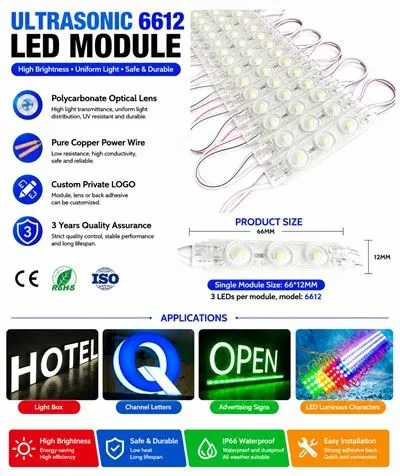
In the dynamic realm of educational technology, the quest for innovative tools that can enhance learning experiences is ever - present. One such potentially transformative device is the Ultrasonic LED Module. As a supplier of Ultrasonic LED Modules, I am excited to explore the viability of these modules in educational projects.
Understanding the Ultrasonic LED Module
Before delving into its educational applications, it's crucial to understand what an Ultrasonic LED Module is. An Ultrasonic LED Module combines the power of ultrasonic technology with the illumination capabilities of LEDs. Ultrasonic waves are sound waves with frequencies higher than the upper audible limit of human hearing. These waves can be used for various functions such as distance measurement, object detection, and sensing environmental conditions. LEDs, on the other hand, are energy - efficient light sources that can provide bright, adjustable illumination.
The integration of these two technologies in a single module creates a versatile device. The ultrasonic component can collect data about the surrounding environment, while the LED can be used to visualize this data or serve as a signal. For example, in a distance - measuring application, the LED could change color or brightness based on how close an object is to the module.
Educational Applications in Science
In science education, the Ultrasonic LED Module can be an invaluable tool. It can be used to teach fundamental concepts in physics, such as sound waves and light. For instance, students can conduct experiments to measure the speed of ultrasonic waves in different mediums. By using the LED to mark the start and end points of the wave's journey, students can more accurately record the time taken for the wave to travel a certain distance. This hands - on approach to learning makes complex scientific concepts more tangible and easier to understand.
Moreover, the module can be used in environmental science classes. Students can use the ultrasonic function to measure the depth of water bodies or the height of trees. The LED can then be used to indicate whether the measured value is within a pre - determined safe or normal range. This not only teaches students about environmental monitoring but also about data interpretation and decision - making.
Applications in Robotics and Engineering
Robotics and engineering courses can also benefit greatly from the use of Ultrasonic LED Modules. In robotics projects, the ultrasonic part of the module can be used for obstacle detection. A robot equipped with an Ultrasonic LED Module can sense when it is approaching an object and use the LED to signal its proximity. This is a basic yet essential concept in autonomous robot navigation.
For engineering students, the module can be used to teach circuit design and programming. They can learn how to interface the ultrasonic sensor and the LED with a microcontroller, write code to control the functions of the module, and optimize the performance of the system. This practical experience gives students a deeper understanding of how electronic components work together to achieve a specific goal.
Enhancing Mathematics Education
Mathematics education can also be enhanced with the help of Ultrasonic LED Modules. When students are measuring distances using the ultrasonic function, they need to apply mathematical formulas to calculate the results accurately. For example, the formula for calculating the distance based on the time taken for an ultrasonic wave to travel and return involves basic arithmetic operations.
In addition, the LED can be used to represent numerical data visually. For example, in a data - collection project, the brightness of the LED could be proportional to a numerical value, such as temperature or pressure. This helps students understand the relationship between numerical data and visual representation, which is an important aspect of data analysis in mathematics.
Comparison with Other LED Modules
While there are other types of LED modules available in the market, such as the Super Bright Led Module, Waterproof IP68 Led Module 12V White, and Cob Led Module 12v, the Ultrasonic LED Module offers unique advantages in an educational context.
The Super Bright LED Module is mainly focused on providing high - intensity illumination, which is great for applications where visibility is the primary concern. However, it lacks the sensing capabilities of the Ultrasonic LED Module. The Waterproof IP68 Led Module 12V White is designed for outdoor or wet - environment use, but it doesn't have the ultrasonic functionality that can be used for data collection. The Cob Led Module 12v is known for its high - power density and uniform light output, but again, it doesn't offer the combined ultrasonic and LED features of the Ultrasonic LED Module.


Challenges and Considerations
Like any educational tool, there are challenges and considerations when using Ultrasonic LED Modules in educational projects. One of the main challenges is the cost. These modules may be more expensive than traditional LED modules or simple sensors. However, the long - term benefits in terms of enhanced learning experiences may outweigh the initial investment.
Another consideration is the technical expertise required to use the module effectively. Teachers may need to undergo training to understand how to integrate the module into their curriculum and troubleshoot any technical issues that may arise. Schools and educational institutions need to provide the necessary support and resources to ensure successful implementation.
Conclusion
In conclusion, the Ultrasonic LED Module has significant potential in educational projects. It can be used across multiple disciplines, including science, robotics, engineering, and mathematics, to enhance learning experiences and make complex concepts more accessible to students. While there are challenges to overcome, the benefits are clear.
If you are an educator, school administrator, or involved in an educational project and are interested in exploring the use of Ultrasonic LED Modules, I encourage you to reach out for more information. We can discuss how these modules can be tailored to your specific educational needs and requirements. Whether you are looking to start a new project or enhance an existing one, our team is ready to assist you in making the most of this innovative technology.
References
- Physics textbooks on sound waves and light.
- Robotics and engineering literature on sensor integration and autonomous navigation.
- Educational research on the use of innovative technologies in the classroom.