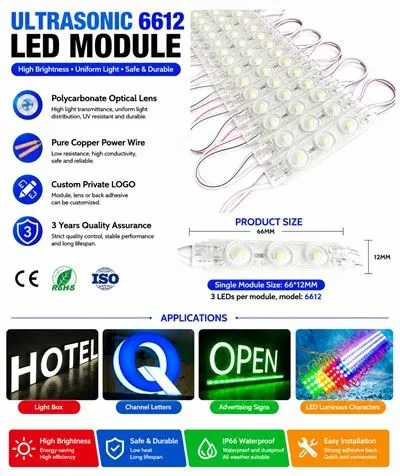
Hey there! As a supplier of 12v Led Module 1.5W, I often get asked about how to check the polarity of these modules. It's a crucial step, especially if you don't want to fry your LED or waste time troubleshooting a non - working setup. So, let's dive right in and learn how to do it the right way.
First off, why is polarity so important for LED modules? Well, LEDs are diodes, and diodes are semiconductor devices that only allow current to flow in one direction. If you connect an LED with the wrong polarity, no current will flow, and the LED won't light up. In some cases, it might even get damaged if you apply reverse voltage for too long.


Visual Inspection
The easiest way to start checking the polarity of a 12v Led Module 1.5W is by doing a visual inspection. Most LED modules have some physical markings that indicate the positive and negative terminals.
- Pin Length: On some LED modules, the longer pin is the positive terminal (anode), and the shorter pin is the negative terminal (cathode). This is a common standard in many simple LED setups. Just take a close look at the pins of your module, and you might be able to tell the difference right away.
- Flat Side or Notch: Another visual cue is the presence of a flat side or a notch on the LED body. Usually, the cathode is on the side with the flat edge or notch. So, if you see a flat side on your 12v Led Module 1.5W, that's a good indication of the negative terminal.
Using a Multimeter
If the visual inspection doesn't give you a clear answer, a multimeter is your best friend. A multimeter is a handy tool that can measure voltage, current, and resistance. Here's how you can use it to check the polarity of your LED module:
- Set the Multimeter: Turn your multimeter to the diode testing mode. This mode is usually represented by a diode symbol on the multimeter dial.
- Connect the Probes: Connect the red probe of the multimeter to one pin of the LED module and the black probe to the other pin. If the LED module lights up dimly and the multimeter shows a reading (usually around 1 - 3 volts), then the red probe is connected to the anode (positive) and the black probe is connected to the cathode (negative).
- Reverse the Probes: If the LED doesn't light up and the multimeter shows an "OL" (overload) or a very high resistance reading, reverse the probes. Keep doing this until the LED lights up, and you'll have identified the correct polarity.
Powering the Module
You can also test the polarity by powering the LED module with a 12v power source. However, you need to be careful when doing this to avoid damaging the module.
- Use a Resistor: Always use a resistor in series with the LED module to limit the current. For a 12v Led Module 1.5W, you can calculate the appropriate resistor value using Ohm's law. The formula is (R=\frac{V - V_{LED}}{I}), where (V) is the supply voltage (12V), (V_{LED}) is the forward voltage of the LED (usually around 2 - 3V), and (I) is the current rating of the LED (you can find this in the module's datasheet).
- Connect the Wires: Connect the positive wire from the power source to one pin of the LED module and the negative wire to the other pin. If the LED lights up, you've got the polarity right. If not, reverse the connections.
Applications and Related Products
Now that you know how to check the polarity of a 12v Led Module 1.5W, let's talk about some of the applications and related products.
- Signage: Our AC110V LED Module for Signage is a great option for creating eye - catching signs. These modules are designed to work with 110V AC power, which is convenient for many commercial applications.
- Dimmable Lighting: If you're looking for more control over the brightness of your LEDs, check out our Dimmable Blockchain Led Light. This innovative product uses blockchain technology to provide precise dimming control.
- Compact Lighting: For those who need a small and efficient lighting solution, our 2835 2leds Module Light is a perfect choice. It's compact, energy - efficient, and easy to install.
Conclusion
Checking the polarity of a 12v Led Module 1.5W is not as complicated as it might seem. With a little bit of knowledge and the right tools, you can quickly identify the positive and negative terminals of your module. Whether you're a DIY enthusiast or a professional installer, getting the polarity right is essential for the proper functioning of your LED setup.
If you're interested in purchasing our 12v Led Module 1.5W or any of our other LED products, don't hesitate to reach out. We're always here to help you with your lighting needs and answer any questions you might have. Let's work together to create the perfect lighting solution for your project!
References
- LED Datasheets from various manufacturers
- Electrical Engineering textbooks on semiconductor devices
- Online resources on LED lighting and electronics