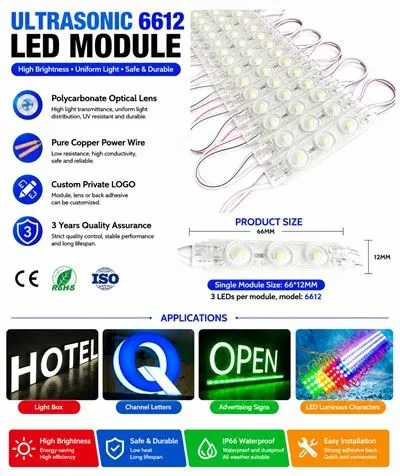
Precisely controlling the brightness of SMD LED modules is crucial for a wide range of applications, from lighting design to electronic displays. As an SMD LED module supplier, I've dealt with numerous customers who have various requirements regarding brightness control. In this blog, I'll share some practical ways to achieve precise brightness control of SMD LED modules.
Understanding the Basics of SMD LED Modules
Before diving into the control methods, it's essential to understand what SMD LED modules are. SMD, or Surface-Mount Device, LED modules are a type of LED package that can be directly mounted onto a printed circuit board (PCB). They come in different sizes, colors, and power ratings, making them versatile for different applications.
We offer a variety of SMD LED modules, such as the Smd Led Injection Module, Side View Led Module 12v, and Economic LED Module 2 LED. Each of these modules has its own characteristics, and the brightness control methods might vary slightly depending on the specific module.
Methods for Controlling Brightness
Pulse Width Modulation (PWM)
PWM is one of the most common and effective ways to control the brightness of SMD LED modules. It works by rapidly turning the LED on and off at a high frequency. The human eye can't detect these rapid on - off cycles, and instead, perceives an average brightness based on the ratio of the on - time to the total cycle time, known as the duty cycle.
For example, if the duty cycle is 50%, the LED is on for half of the time and off for the other half. This results in the LED appearing to be at half of its maximum brightness. By adjusting the duty cycle, you can precisely control the brightness of the LED module.
To implement PWM, you'll need a microcontroller or a dedicated PWM driver. The microcontroller can generate the PWM signal with a specific duty cycle, which is then sent to the LED module. Most modern microcontrollers, like Arduino, have built - in PWM capabilities, making it relatively easy to set up.
Analog Dimming
Analog dimming is another method for controlling LED brightness. Instead of rapidly turning the LED on and off, analog dimming changes the voltage or current supplied to the LED module. By reducing the current flowing through the LED, the brightness decreases proportionally.
However, analog dimming has some drawbacks. One of the main issues is color shifting. As the current through the LED decreases, the color of the light emitted by the LED can change slightly. This is because the forward voltage and the emission spectrum of the LED are affected by the current.
Another problem is that analog dimming might not be as precise as PWM, especially at low brightness levels. At low currents, the LED might not turn on uniformly, leading to uneven brightness across the module.
Digital Dimming
Digital dimming is a more advanced method that uses digital signals to control the brightness of the LED module. It offers high precision and can be used to control multiple LED modules independently.
Digital dimming often involves using a communication protocol, such as I2C or SPI, to send commands to the LED driver. The LED driver then adjusts the brightness of the LED module according to the received commands. This method is particularly useful in applications where you need to control a large number of LEDs or where you want to have more complex brightness control patterns.
Factors Affecting Brightness Control
Temperature
Temperature can have a significant impact on the brightness of SMD LED modules. As the temperature increases, the forward voltage of the LED decreases, which can cause the LED to draw more current if the power supply is not regulated properly. This can result in an increase in brightness, even if the control signal remains the same.
To compensate for temperature effects, you can use a temperature sensor to monitor the temperature of the LED module. The microcontroller can then adjust the PWM duty cycle or the current based on the measured temperature to maintain a consistent brightness.
Power Supply Stability
A stable power supply is essential for precise brightness control. Fluctuations in the power supply voltage can cause the brightness of the LED module to vary. For example, if the voltage drops, the LED might become dimmer, and if the voltage increases, the LED might become brighter.


To ensure a stable power supply, you can use a voltage regulator or a switching power supply. These devices can maintain a constant output voltage, even if the input voltage varies.
Choosing the Right Method for Your Application
When choosing a brightness control method for your SMD LED module, you need to consider several factors.
If you need high precision and want to avoid color shifting, PWM is usually the best choice. It's suitable for applications such as stage lighting, where precise brightness control is crucial.
Analog dimming can be a simpler and more cost - effective option if you don't mind a slight color shift and if you only need to control the brightness within a certain range. It's often used in applications where cost is a major concern, such as general lighting in homes or offices.
Digital dimming is ideal for applications that require complex control and high precision, such as in large - scale LED displays or in automotive lighting systems.
Practical Tips for Precise Brightness Control
Calibration
Before using the LED module in your application, it's a good idea to calibrate the brightness control. You can use a light meter to measure the actual brightness of the LED module at different control settings. This will help you establish a relationship between the control signal (PWM duty cycle, analog voltage, etc.) and the actual brightness.
Testing
Test the brightness control under different conditions, such as different temperatures and power supply voltages. This will help you identify any potential issues and make adjustments to ensure consistent brightness control.
Conclusion
Precisely controlling the brightness of SMD LED modules is achievable with the right methods and considerations. Whether you choose PWM, analog dimming, or digital dimming, understanding the characteristics of your LED module and the factors that can affect brightness control is essential.
At our company, we're committed to providing high - quality SMD LED modules and helping our customers find the best brightness control solutions for their applications. If you're interested in purchasing our SMD LED modules or need more information about brightness control, feel free to contact us for procurement and further discussions.
References
- "LED Lighting Handbook" by some well - known lighting experts.
- Technical documents from LED manufacturers on SMD LED modules.