

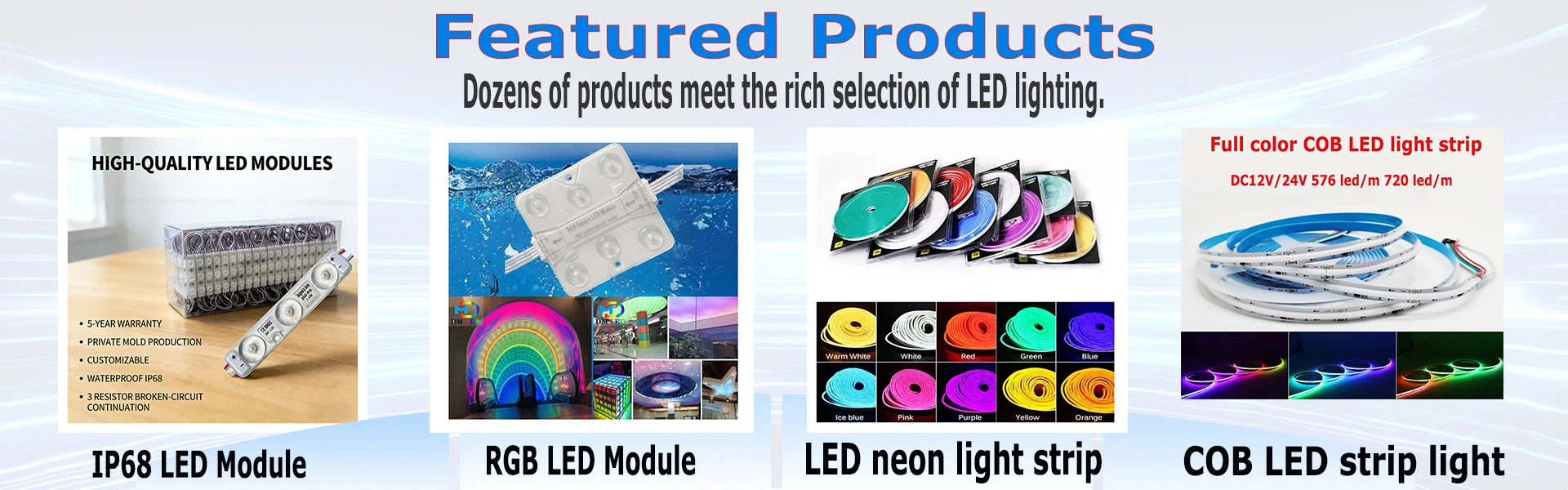
LED modules are widely used in LED products, and there are also great differences in structure and electronics. The simple thing is to use a circuit board and shell with LED to become an LED module. The complex thing is to add some control, constant current source and related heat dissipation treatment to make the LED life and luminous intensity better.
The LED module is composed of a LED quadrangle module integrated with multiple rows and columns, and at least one side of the quadrangle module is an edge with more than one set of concave convex slot blocks. The quadrilateral module can have at least one set of opposite side and two walls with more than one set of concave and convex groove blocks, wherein, the two opposite side concave and convex groove blocks can be in corresponding or symmetrical shape.
Parameters:
1. Color: It can be divided into single color, seven color, double primary color and full-color single point control according to color types.
2. Voltage: 12V low-voltage modules are common. When connecting the power supply and control system, be sure to check the correctness of the voltage value before powering on, otherwise the LED module will be damaged.
3. Operating temperature: the temperature at which the LED works normally. Generally, it is between - 20 ℃ and+60 ℃.
4. Luminous angle: generally, the luminous angle of LED provided by the manufacturer is the angle of LED module.
5. Brightness: The brightness we usually refer to in LED modules is the luminous intensity and lumen.
6. Waterproof grade: this parameter is very important if LED modules are used outdoors. Generally, the waterproof grade should reach IP65 in the open air, but it cannot be completely waterproof.


