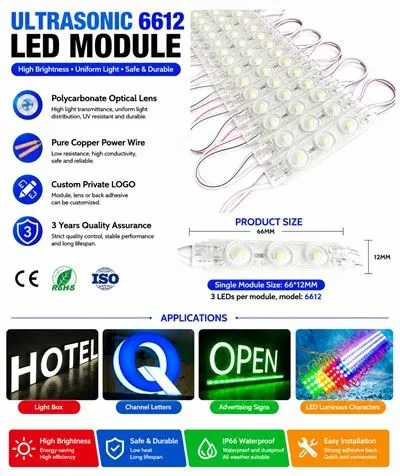
Hey there! As a supplier of Ultrasonic Led Modules, I often get asked about how much power these nifty little devices need. It's a great question, and today, I'm gonna break it down for you in a way that's easy to understand.
First off, let's talk about what an Ultrasonic Led Module is. It's a combination of ultrasonic technology and LED lighting. Ultrasonic tech can be used for various purposes like detecting movement or even repelling pests in some cases, while the LED part provides light. These modules are super versatile and can be used in a bunch of different settings, from home security systems to outdoor lighting setups.
Now, when it comes to power requirements, it's not a one - size - fits - all answer. There are several factors that can influence how much power an Ultrasonic Led Module needs.
Factors Affecting Power Consumption
1. LED Type and Quantity
The type of LEDs used in the module plays a huge role. For example, high - brightness LEDs will generally consume more power than lower - brightness ones. Also, the number of LEDs in the module matters. A module with more LEDs is going to need more power to light them all up.
Let's take a look at some of our products. Our 12v 2835 Injection Led Module uses 2835 LEDs. These are relatively energy - efficient LEDs, and the power consumption of this module is designed to be on the lower side, making it a great choice for applications where power conservation is important.
2. Ultrasonic Functionality
If the module has ultrasonic features, the power needed for the ultrasonic part can vary. Some ultrasonic functions are low - power, like basic motion detection, while others that are more complex, such as high - range pest repelling, might require more power.
Our High Power Ultrasonic Led Module 12V is a good example of a module with more advanced ultrasonic functionality. It has a high - power ultrasonic emitter that can cover a larger area. This means that in addition to the power needed for the LEDs, there's extra power required to run the ultrasonic part.
3. Operating Mode
The way the module is set to operate also affects power consumption. For instance, if it's set to be on constantly, it will use more power compared to a mode where it only turns on when triggered, like in a motion - activated setup.
Let's say you have a security light in your backyard. If you set it to be on all night, it's going to consume a fair amount of power. But if you set it to turn on only when it detects motion, it'll save a lot of energy. Our modules can be configured in different operating modes to suit your needs.
Typical Power Requirements
In general, most of our Ultrasonic Led Modules operate on a 12V power supply. This is a common voltage in many electrical systems, making it easy to integrate our modules into existing setups.
For smaller modules with basic functionality, like the 1.5w Led Module Light, the power consumption is around 1.5 watts. These are great for small - scale applications, like accent lighting in a room or a small outdoor area.
On the other hand, larger modules with more LEDs and advanced ultrasonic features can consume anywhere from 5 to 15 watts or more. It really depends on the specific design and functionality of the module.
Calculating Power Usage
If you're trying to figure out how much power your Ultrasonic Led Module will use over a certain period, it's actually quite simple. You just need to know the power rating (in watts) of the module and the number of hours it will be in use.
The formula is: Power (in kilowatt - hours) = (Power rating in watts × Hours of use) / 1000
Let's say you have a 5 - watt Ultrasonic Led Module and you run it for 10 hours a day. The daily power consumption would be (5 × 10) / 1000 = 0.05 kilowatt - hours.
Saving Power
If you're concerned about power consumption, there are a few things you can do. First, choose a module with energy - efficient LEDs. As I mentioned earlier, our 2835 - based modules are a good option.
Second, use the operating mode settings to your advantage. Set the module to turn on only when needed, like in a motion - activated or timer - based mode.
Also, make sure to properly maintain the module. A dirty or damaged module might not operate as efficiently, which can lead to higher power consumption.
Conclusion
So, as you can see, the power requirements of an Ultrasonic Led Module can vary widely depending on several factors. Whether you need a low - power module for a small project or a high - power one for a large - scale application, we've got you covered.


If you're interested in learning more about our Ultrasonic Led Modules or have any questions about power consumption, feel free to reach out. We're here to help you find the perfect module for your needs and ensure that you're getting the most out of it in terms of both performance and energy efficiency. Contact us to start a procurement discussion and find the right Ultrasonic Led Module for your project.
References
- General knowledge of LED and ultrasonic technology in the lighting industry.
- Product specifications of our Ultrasonic Led Modules.