

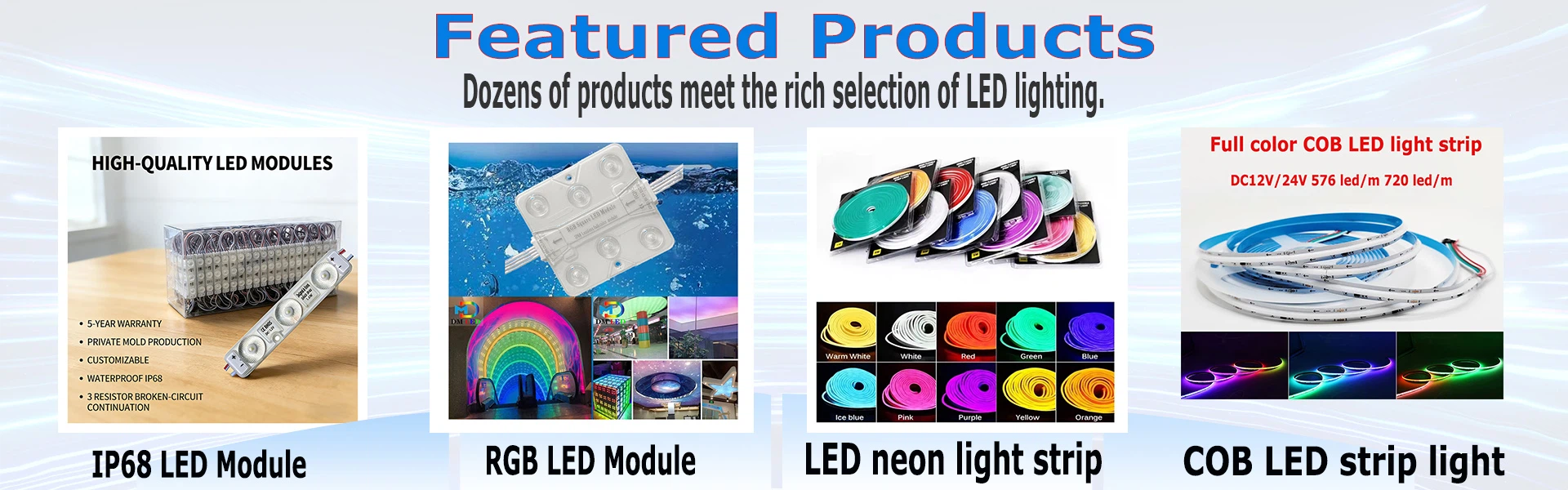
Firstly, the installation of the square RGBIC LED full-color module designed and produced by DMLED is very simple. Due to its square design, it can be easily assembled into light boxes or soft film ceilings of different sizes without the need for complex installation tools and steps, saving time and effort. Even if there are problems during on-site installation, it is easy to replace or adjust the position, which is convenient and fast. Especially for the installation and application of irregular light boxes or soft film ceilings, its characteristics are more obvious
Secondly, the square LED full-color module we produce has excellent waterproof performance. Our IP68 square RGBIC LED module is applied to large light boxes and soft film ceilings, which has good waterproof performance to cope with various complex outdoor environments. The IP68 square LED full-color module adopts an integrated optical lens and a reverse injection molding filling design, which can effectively prevent the immersion of water vapor, rainwater and other liquids. It is also not easily corroded by humid climate after long-term use, ensuring the stability and service life of the product. Can provide customers with a better experience and feeling
Overall, the application of square RGBIC LED modules in large lightboxes and soft film ceilings not only has the advantages of easy installation and good waterproof performance, but also brings more colorful lighting effects, enhancing the overall decorative effect. I believe that in the future development, LED modules will be more widely used in various indoor and outdoor scenarios, bringing people a better and brighter world. May the application of LED full-color modules in large light boxes and soft film ceilings bring more warmth and beauty to our lives.
The installation method for square RGBIC LED modules is actually very simple, with an arrow on the silk screen of our module. The signal goes down in the direction of the arrow. Be careful not to install it against the arrow direction. At the same time, it is also necessary to supplement the voltage. To avoid the problem of reduced brightness caused by voltage drop due to long-distance transmission. I believe many people will understand this question, so I won't go into too much detail here. Regarding the issue of signal connection. Our RGBIC modules all use SPI signal transmission for data, using the 1935IC with breakpoint resume function. There are 4 access lines. The leftmost and rightmost two are positive and negative poles, respectively connected to the positive and negative poles of the power supply. The two lines in the middle represent the main signal line for DI and the auxiliary signal line for BI. Just connect the main and auxiliary signal lines corresponding to the controller separately. Below, I will use a diagram to illustrate its connection method. If anyone still has any questions, feel free to leave me a message and I will reply promptly


