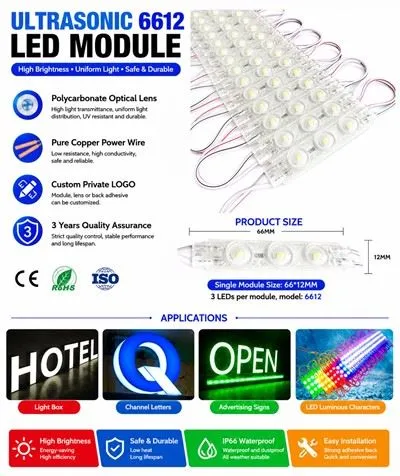
When it comes to the world of lighting, LED modules have emerged as a revolutionary technology, offering energy - efficiency, long lifespan, and high - quality illumination. As a supplier of 12V LED modules with a power rating of 1.5W, I am often asked about the power conversion efficiency of these products. In this blog, I will delve into the concept of power conversion efficiency, explain how it is measured in 12V 1.5W LED modules, and discuss its importance in the context of our offerings.
Understanding Power Conversion Efficiency
Power conversion efficiency is a crucial metric in the field of electronics, especially for devices that convert electrical energy into other forms of energy, such as light in the case of LED modules. It is defined as the ratio of the useful output power to the total input power, expressed as a percentage. Mathematically, it can be represented as:
[ Efficiency (\eta)=\frac{P_{out}}{P_{in}}\times100% ]
where (P_{out}) is the output power (in our case, the power of the light emitted by the LED module) and (P_{in}) is the input power (the electrical power supplied to the module).
For a 12V 1.5W LED module, the input power is straightforward. If the module is designed to operate at 12V and has a power rating of 1.5W, the input power (P_{in} = 1.5W) under normal operating conditions. However, not all of this input power is converted into visible light. Some of it is lost as heat due to the internal resistance of the components within the LED module, such as the driver circuit and the LED chips themselves.
Measuring Power Conversion Efficiency in 12V 1.5W LED Modules
To measure the power conversion efficiency of a 12V 1.5W LED module, we need to accurately determine both the input power and the output power.
Input Power Measurement
The input power can be measured using a power meter. A power meter is connected in series with the LED module in the electrical circuit. It measures the voltage across the module and the current flowing through it. Using the formula (P = VI) (where (V) is the voltage and (I) is the current), the input power can be calculated. For a 12V LED module, we ensure that the power supply provides a stable 12V voltage, and the power meter records the current consumption. If the measured current is (I) amperes, then the input power (P_{in}=12V\times I). In an ideal scenario, for a 1.5W rated module, if the efficiency were 100%, the current would be (I=\frac{1.5W}{12V}=0.125A).
Output Power Measurement
Measuring the output power, which is the power of the light emitted by the LED module, is more complex. We typically use a device called an integrating sphere. An integrating sphere is a hollow spherical cavity with a highly reflective interior surface. The LED module is placed inside the integrating sphere, and the light it emits is scattered and reflected multiple times within the sphere. A detector is then used to measure the total amount of light energy within the sphere. This measurement is usually given in lumens (lm), which is a unit of luminous flux.
To convert the luminous flux from lumens to power (in watts), we need to use the concept of luminous efficacy. Luminous efficacy is defined as the ratio of the luminous flux (in lumens) to the power (in watts). Different types of LEDs have different luminous efficacies. For example, high - quality white LEDs can have a luminous efficacy of around 100 - 200 lm/W.
Let's say we measure the luminous flux of our 12V 1.5W LED module to be (L) lumens. If the luminous efficacy of the LEDs in the module is (E) lm/W, then the output power (P_{out}=\frac{L}{E}) watts.

Once we have both (P_{in}) and (P_{out}), we can calculate the power conversion efficiency using the formula mentioned earlier.
Factors Affecting Power Conversion Efficiency
Several factors can affect the power conversion efficiency of a 12V 1.5W LED module.
LED Chip Quality
The quality of the LED chips is one of the most significant factors. High - quality LED chips are designed to have a higher internal quantum efficiency, which means they can convert a larger proportion of the electrical energy into light. Cheaper or lower - quality LED chips may have a lower internal quantum efficiency, resulting in more energy being lost as heat and a lower overall power conversion efficiency.
Driver Circuit Design
The driver circuit is responsible for regulating the voltage and current supplied to the LED chips. A well - designed driver circuit can minimize power losses. For example, a driver circuit with a high power factor correction (PFC) can reduce the amount of reactive power in the circuit, improving the overall efficiency. On the other hand, a poorly designed driver circuit may have high internal resistance, leading to significant power losses in the form of heat.
Thermal Management
Heat is the enemy of LED efficiency. As the temperature of the LED chips increases, their efficiency decreases. A good thermal management system, such as a heat sink or a thermal pad, can help dissipate the heat generated by the LED chips, keeping their temperature within an optimal range. This, in turn, helps maintain a higher power conversion efficiency.
Importance of Power Conversion Efficiency for Our 12V 1.5W LED Modules
As a supplier of 12V 1.5W LED modules, power conversion efficiency is of utmost importance for several reasons.
Energy Savings
High - efficiency LED modules consume less electrical energy to produce the same amount of light compared to low - efficiency ones. This translates into significant energy savings for our customers, whether they are using our modules for residential, commercial, or industrial lighting applications. For example, in a large - scale commercial lighting project, using high - efficiency LED modules can result in substantial cost savings on electricity bills over the long term.
Environmental Impact
By offering LED modules with high power conversion efficiency, we are contributing to a more sustainable environment. Lower energy consumption means reduced greenhouse gas emissions associated with electricity generation. As the demand for environmentally friendly lighting solutions continues to grow, our high - efficiency LED modules are well - positioned to meet this market need.
Product Competitiveness
In a highly competitive market, power conversion efficiency is a key selling point. Customers are increasingly looking for LED modules that offer the best combination of performance and energy efficiency. Our ability to provide 12V 1.5W LED modules with high power conversion efficiency gives us a competitive edge over other suppliers.
Our Product Range
We offer a diverse range of 12V 1.5W LED modules to meet the different needs of our customers. Some of our popular products include the 12v 1.5w Led Backlight Module, which is ideal for backlighting applications such as signage and displays. It is designed to provide uniform and bright illumination with high power conversion efficiency.
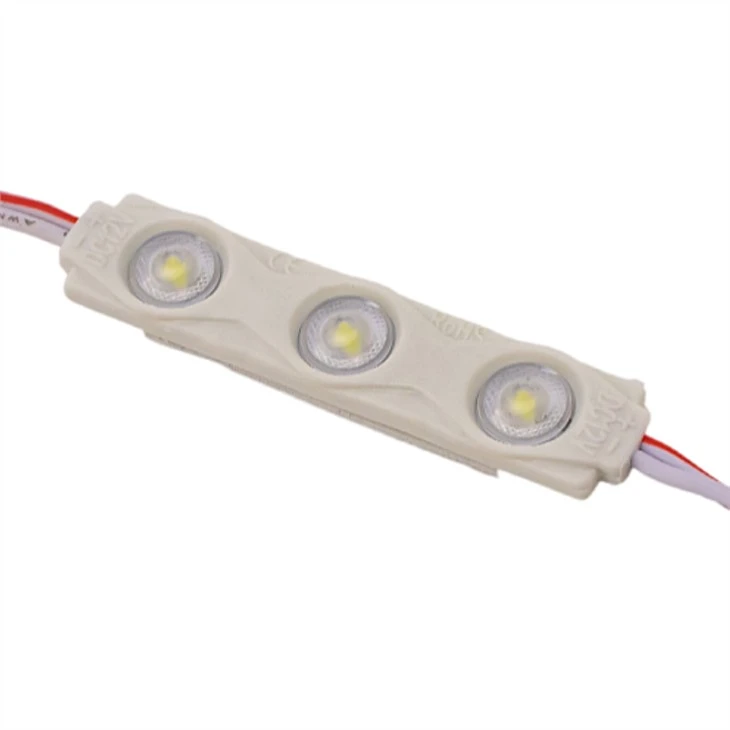
Another product in our portfolio is the 12v Ultrasonic Led Module 1.5W. This module combines the benefits of LED lighting with ultrasonic technology, offering features such as motion detection and energy - saving capabilities.
We also have LED Modules For Light Box, which are specifically designed for light box applications. These modules are engineered to provide high - quality, even lighting with excellent power conversion efficiency.
Contact Us for Procurement
If you are interested in our 12V 1.5W LED modules and want to learn more about their power conversion efficiency or discuss your specific lighting requirements, we encourage you to get in touch with us. Our team of experts is ready to assist you with product selection, technical support, and procurement details. Whether you are a small - scale retailer or a large - scale lighting contractor, we can provide you with the right LED modules at competitive prices.
References
- "LED Lighting Technology: Principles and Applications" by John Reay
- "Power Electronics: Converters, Applications, and Design" by Ned Mohan, Tore M. Undeland, and William P. Robbins